
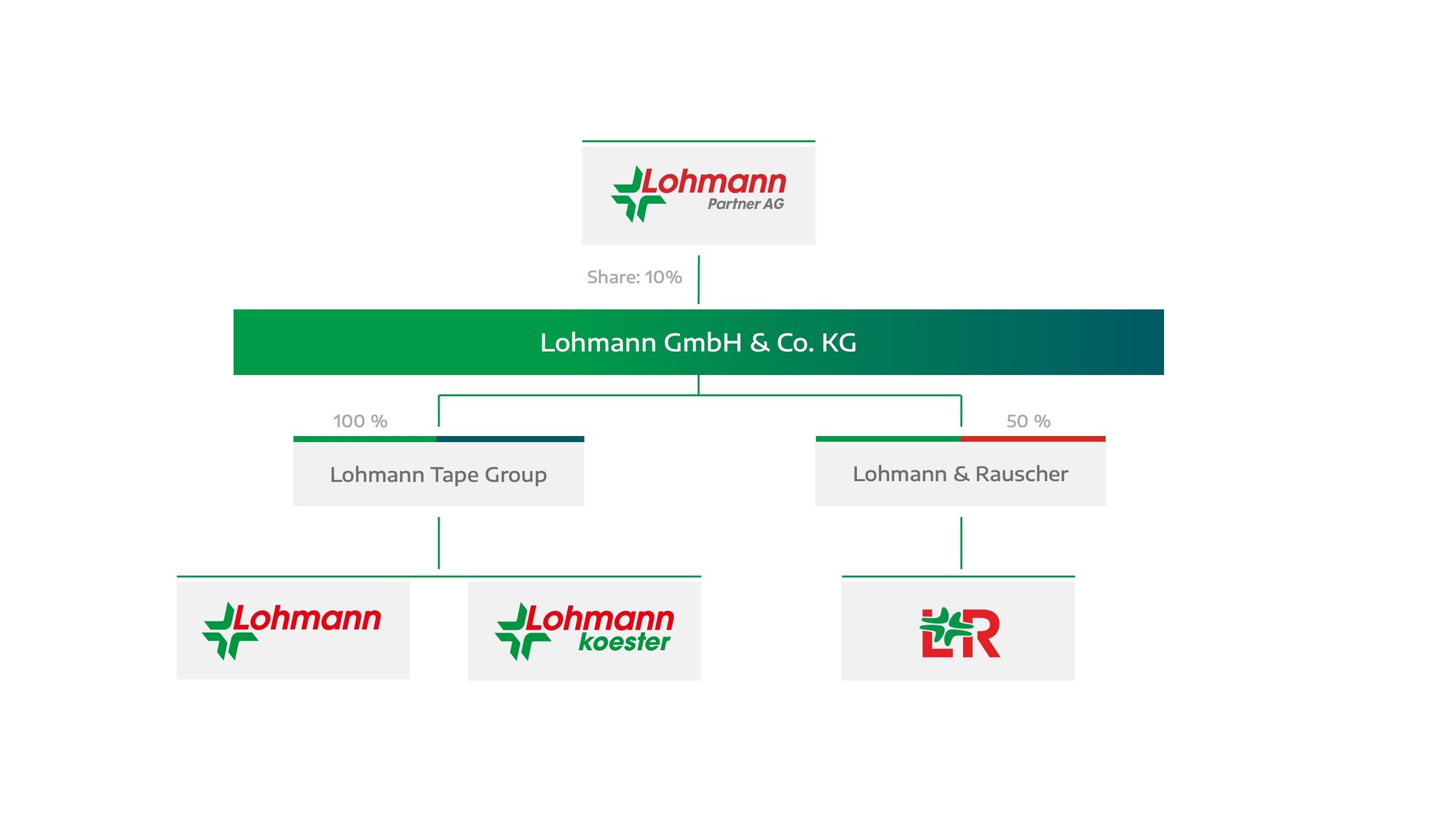

Lohmann Partner AG is the largest single shareholder of Lohmann GmbH & Co KG with a 10% stake in the company. The shareholders benefit from the business success of both the Lohmann Tape Group and Lohmann & Rauscher.
It was founded in 1976 and converted into a stock corporation in 1992. There are currently 430,000 shares issued, which are held by around 800 shareholders. A 1:5 share split was carried out in 2015.
The Executive Board of Lohmann-Partner AG is appointed by the Supervisory Board for five years. It consists of Dr. Jörg Pohlman and Olaf Roth. They manage the company and prepare the annual financial statements.
The Supervisory Board is elected by the Annual General Meeting for a period of five years. Its tasks include appointing the Management Board, monitoring business activities and auditing and approving the annual financial statements. The members of the Supervisory Board are Werner Barth (Chairman), Marion Rings (Deputy Chairman), Monika Ebing, Edgar Ehrhardt, Reinhard Koch and Frank Schlößer.
The Annual General Meeting is the highest decision-making body of the stock corporation, which passes the fundamental company resolutions. It is also known as the "parliament of shareholders". It takes place once a year in August at the company's headquarters in Neuwied. The Annual General Meeting decides on the Articles of Association, elects the Supervisory Board, decides on the appropriation of net profit and the dividend payment and approves the actions of the Management Board and Supervisory Board.
Lohmann-Partner AG Structure

Share trading
The Lohmann-Partner share represents a share in the company and is therefore also exposed to entrepreneurial risk. As a result, fluctuations in the share price are possible. The shares are not listed on the stock exchange, but are traded privately.
Share trading is organized by Lohmann-Partner AG. The share price is negotiated between buyer and seller and is thus determined by supply and demand.
Due to the lower liquidity of the share, the execution of buy/sell orders may take some time depending on the number of shares. Anyone who decides to buy shares should therefore consider this form of investment as a long-term investment.
Interested parties who wish to buy shares or shareholders who wish to sell shares can place a corresponding brokerage order with Lohmann-Partner AG. You will find the relevant forms to download in our download center .
Downloadcenter:
Forms: (Please fill in both forms if you change your address.)

Share price
Return
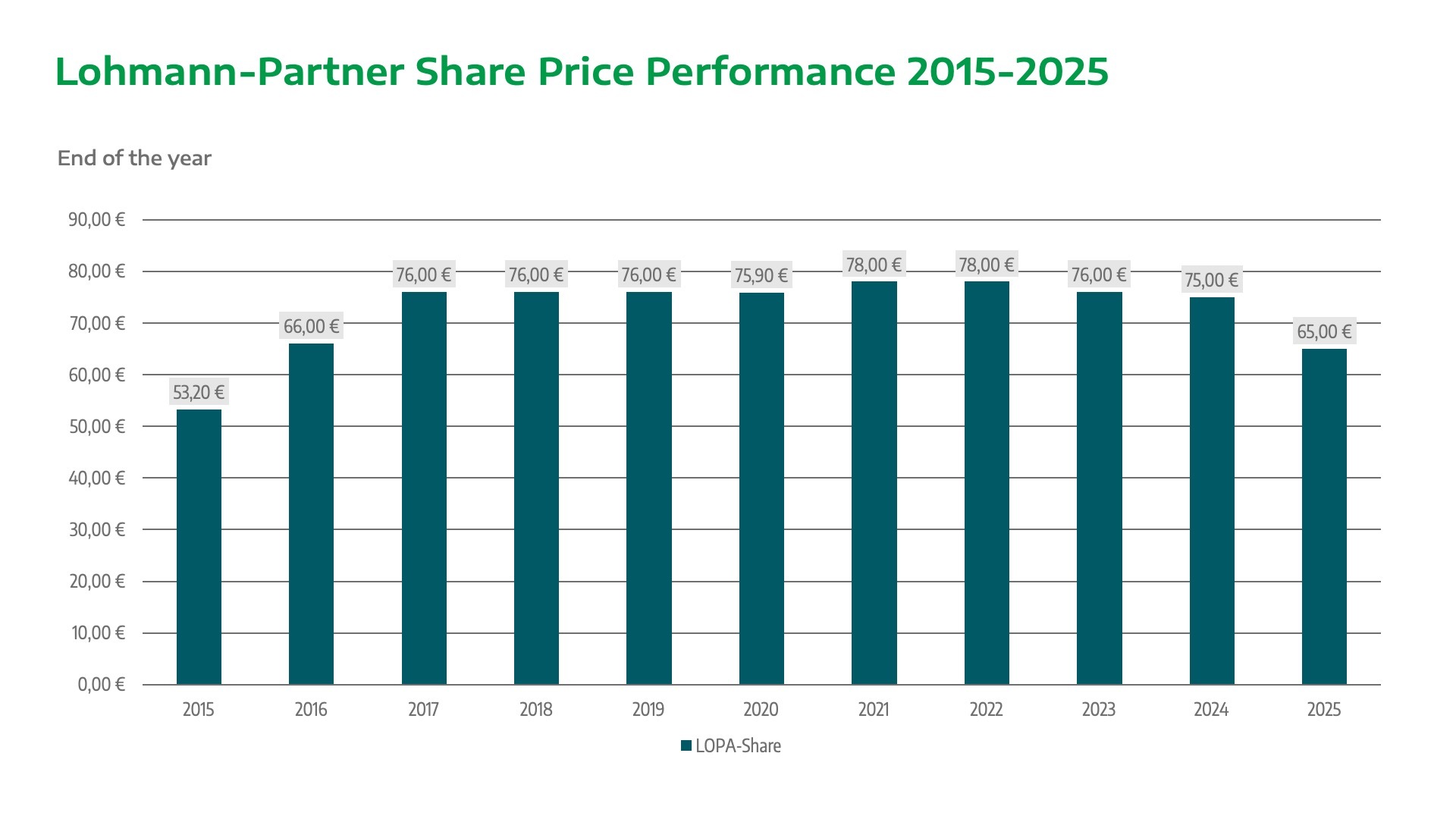
In recent years, Lohmann-Partner shares have been characterized by a positive share price performance.
The following chart shows the price of Lohmann Partner shares (blue bars) compared with the year-end prices of the German DAX share index (green line / normalized to the starting value of € 41.90). The German share index DAX is the compilation of the 40 largest German stock market shares.
While Lohmann-Partner shares rose from € 41.90 in 2014 to € 75.00 in 2024 (1st half of the year) (+79%), the DAX rose from 9,805 points to 18,235 points (+86%). The year-end prices fluctuated between 9,805 points in 2014 and 18,235 points in 2024. The prices of Lohmann-Partner shares are shown taking into account the 1:5 share split carried out in 2015.
The profit of Lohmann-Partner AG is based on the distribution of Lohmann GmbH & Co. Depending on the profit, a dividend is distributed to the shareholders.
The following chart shows the annual dividend distribution of Lohmann-Partner AG.
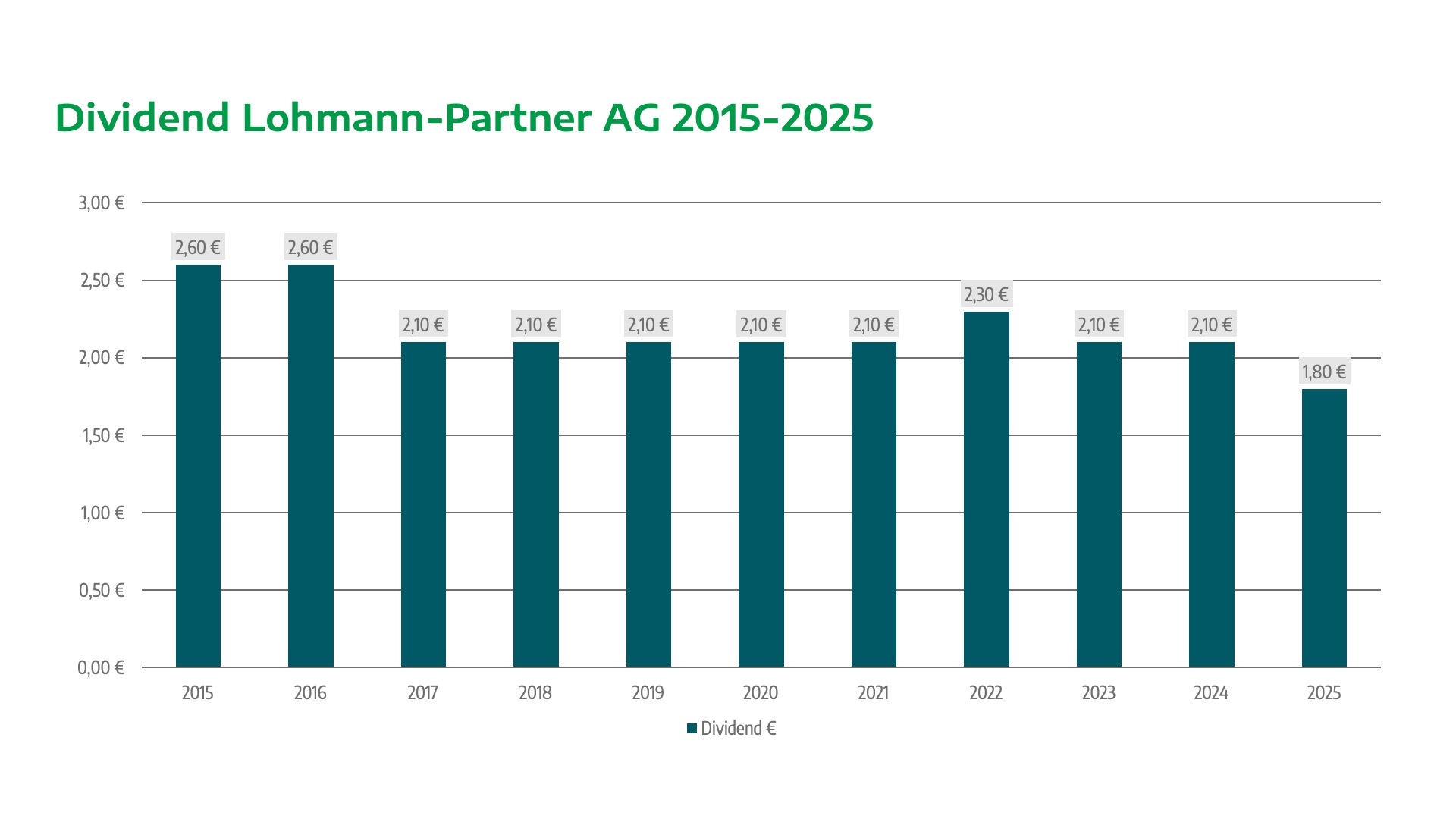
The average dividend over the last 10 years was €2.22 per share.
The dividend yield, which is a benchmark for the valuation of an investment, is calculated from the ratio of the dividend to the share price.
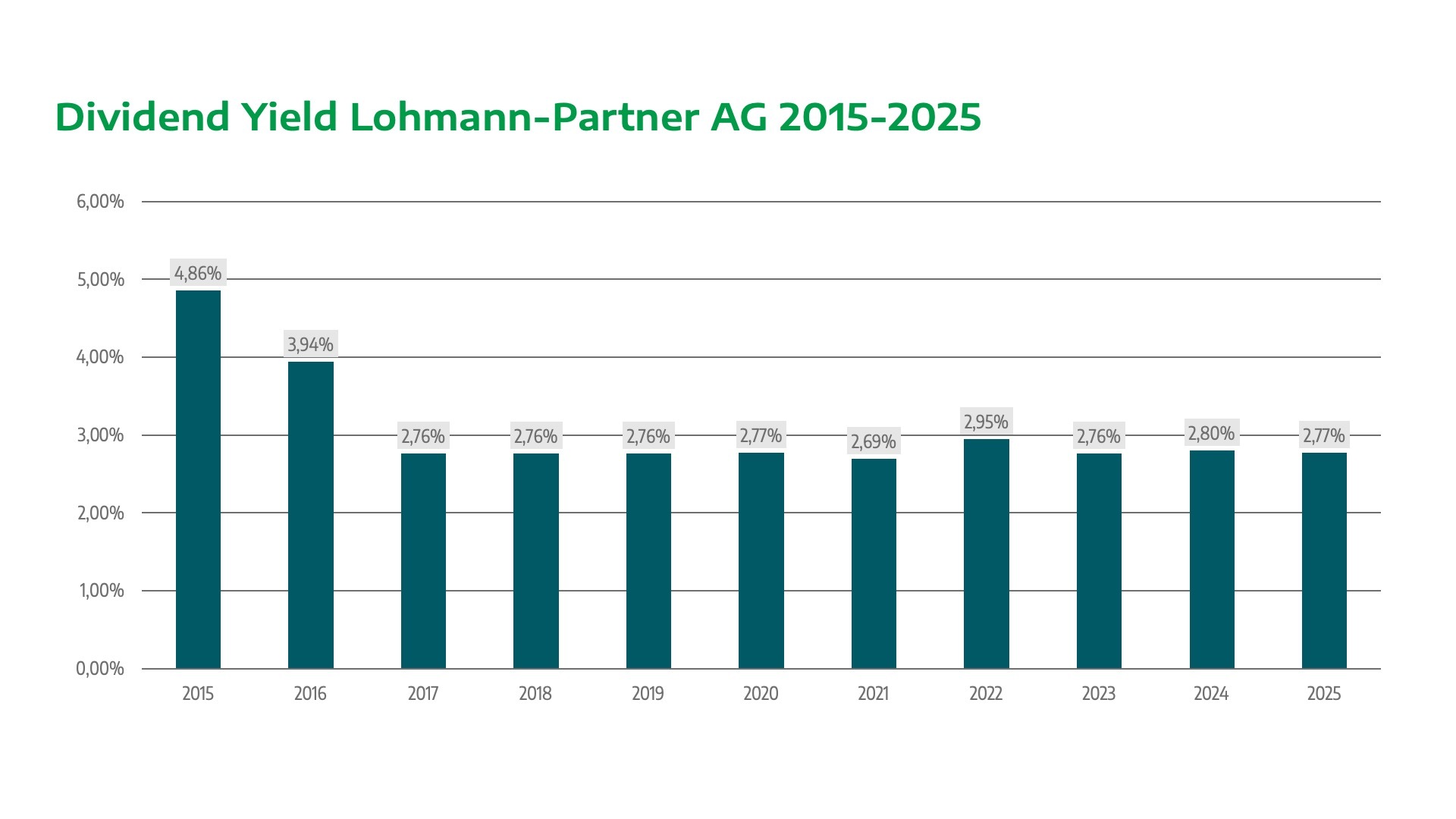
The average dividend yield over the last 10 years was 3.30%.
The regular reinvestment of dividends in shares can lead to further capital accumulation over the years. The following chart shows the performance of reinvesting the dividend.
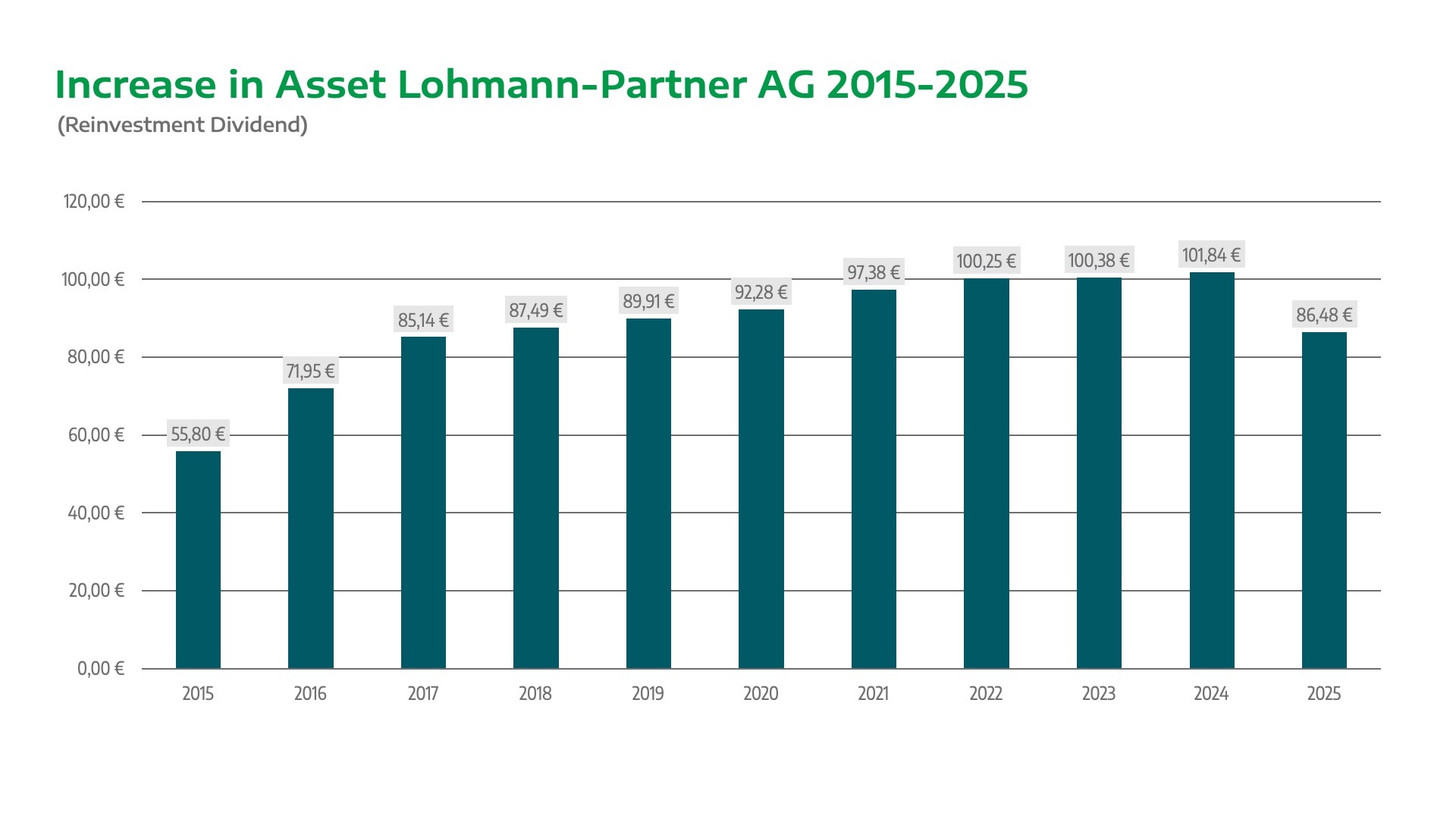
From a share with a value of € 41.90 in 2014, assets of € 101.84 would have arithmetically been created by reinvesting the dividend annually in new shares at the current price by 2024. This would correspond to an increase in value of € 59.94 or +143% or +14.3% per year.
Note: This is a theoretical calculation, as fractions of shares must be taken into account.
Frequently asked questions - and answers
What is a registered share with restricted transferability? keyboard_arrow_down
Lohmann-Partner AG has issued registered shares with restricted transferability. The owner of a registered share is entered by name in the share register of the stock corporation. The stock corporation thus knows its shareholders. The addition "with restricted transferability" means that the Board of Directors of the stock corporation must approve the transfer of shares to new owners. Approval can be refused if new shareholders harm the interests of the public limited company - for example, if they are competing companies.
Who can buy shares and become a Lohmann partner? keyboard_arrow_down
Shares in circulation can be purchased by employees, family members, pensioners and interested third parties at any time at freely negotiated prices. New shares at the preferential price can only be purchased by employees. A lock-up period of two years then applies to the sale. All companies in the Lohmann Group in which Lohmann GmbH & Co. KG holds at least 50 percent of the shares belong to the group of employees entitled to do so.
What happens when employees leave the Lohmann Group? keyboard_arrow_down
Retired employees can also remain shareholders. Many retirees use the annual dividend as a supplementary pension.
How can shares be bought or sold? keyboard_arrow_down
The Lohmann Central Functions department acts as a kind of stockbroker and brings prospective buyers and sellers together. Anyone wishing to buy or sell should contact Silke Sartor (phone 02631/ 34 6767) or Olaf Roth (02631/34 6819), stating the desired number and price of shares. Corresponding forms are also available in the "Downloads/Forms" section.
Can a savings contract be set up for the purchase of shares? keyboard_arrow_down
It is also possible to acquire shares as part of a savings contract, under which regular savings amounts are deducted from wages, salaries or special payments and credited to a savings account (minimum € 25.00 per month). Once a year after the Annual General Meeting, the savings balance is invested in shares. Until then, the savings balance earns interest in the same way as the loan balance (interest rate: 3-month EURIBOR + 1% / 3.02% in the 4th quarter of 2025).
How many shares can a shareholder buy? keyboard_arrow_down
The maximum shareholding is currently set at 62,500 shares per shareholder (taking into account the 1:5 share split in 2015)
Where are the shares kept? keyboard_arrow_down
The shares are held exclusively in custody accounts at Sparkasse Neuwied. There are no costs for the shareholder. The dividend is credited without deduction of capital gains tax on presentation of an exemption order.
How high is the dividend? keyboard_arrow_down
The dividend is a profit-related payment to shareholders. The amount of the dividend is decided annually by the Annual General Meeting. The amount is primarily based on the balance sheet profit and the economic prospects of the company. Past dividend payments are listed under the menu item "Share price return".
What is the dividend yield? keyboard_arrow_down
The dividend yield is a key figure for the percentage of a public limited company's dividend payout in relation to the share price. It measures the return on capital employed. It is calculated by setting the dividend in relation to the purchase price of the share.
What happens to the dividend? keyboard_arrow_down
The dividend distributions flow into a credit account of the shareholder at Lohmann-Partner AG, where they earn interest (interest rate: 3-month EURIBOR + 1% / 3.02% in Q4 2025). The shareholder can freely dispose of this money and use it to buy new shares. They can leave the dividends interest-bearing or have them transferred to a bank account for free use.
What role does Sparkasse Neuwied play? keyboard_arrow_down
Sparkasse Neuwied is the custodian bank responsible for the proper booking of the shares. After buying or selling the shares, the buyer and seller receive a corresponding booking notification. At the end of the year, Sparkasse Neuwied sends all shareholders a securities account statement showing the number of shares. As there is no stock market price for the Lohmann-Partner share, the share value is formally stated as "0". Shareholders can issue an exemption order to Sparkasse Neuwied so that no taxes have to be deducted from the dividend distribution.
How do I issue an exemption order? keyboard_arrow_down
The exemption order must be issued to Sparkasse Neuwied. Please call your personal customer advisor or the securities and investment advisory service, Mr. Sahm (Tel. 02631 / 806-4628). Exemption orders already issued with Sparkasse Neuwied also apply to Lohmann-Partner shares.
Why does the loan account exist? keyboard_arrow_down
A loan account will be set up with Lohmann-Partner AG for each shareholder to simplify the processing of dividend payments. This is an interest-bearing credit account (3-month EURIBOR + 1% / 3.02% in Q4 2025), which shareholders can freely dispose of. Payments into this account are only possible for the purchase of shares. At the end of the year, shareholders receive an account statement with all account movements and the interest statement. Interest is credited without deduction of tax. Nevertheless, this interest income is taxable and must be declared in the income tax return. No exemption order can be issued for the loan account.
What are the opportunities and risks? keyboard_arrow_down
The opportunities and risks typically associated with an equity investment apply to the Lohmann partner share. The Lohmann partner share represents an equity participation in Lohmann. This means that shareholders participate in Lohmann's financial success and also bear the entrepreneurial risk. Fluctuations in the share price are possible. The share is less liquid than listed shares because there are not always an equal number of potential buyers and sellers. In general, a long-term investment horizon is required.
Do you have any questions or need help?
Silke Sartor and Olaf Roth will be happy to help you.